Commercial Roof Seam Failure Repair in College Station, TX
Commercial Roof Seam Failure Repair
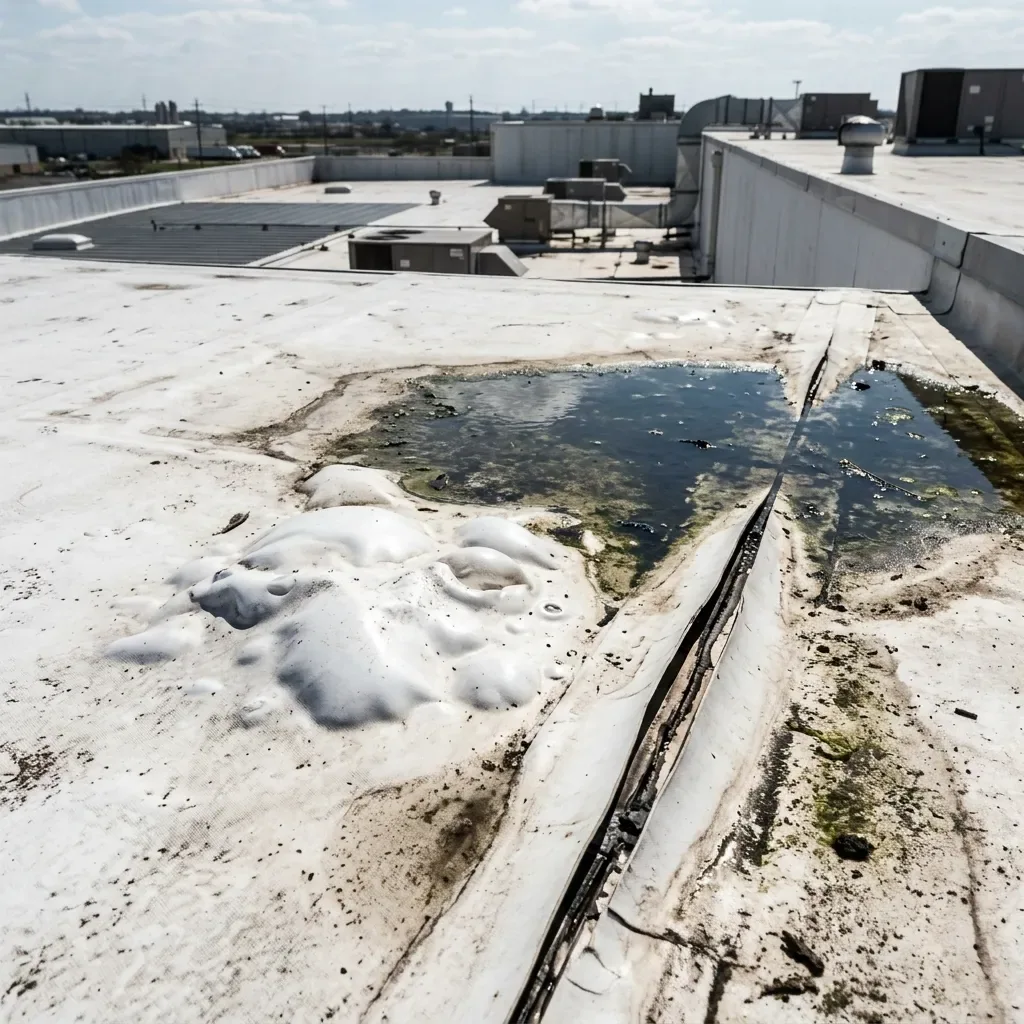
A seam failure can begin as a narrow opening between sheets or plies and become a wider leak path after repeated movement, wetting, or poor patch preparation. We locate the affected run, identify the roof assembly, and inspect nearby terminations, penetrations, and drainage before defining the repair. The report distinguishes an isolated seam defect from a repeated pattern that may point to attachment or material condition. In Bryan and College Station, office, research, health-science, retail, manufacturing, and light-industrial buildings bring different rooftop service needs and access rules.
We mark each finding on the roof plan and connect it to leak history where evidence supports that relationship. The National Weather Service recorded hail and severe wind events in the area, but event history does not prove the cause of a particular opening. A commercial roof inspection can document current seam condition and the repair boundary.

Identify the Seam Before Choosing a Repair
Roof seams differ by system. Thermoplastic membranes use welded laps; EPDM and other sheet materials may rely on tape, adhesive, or a mechanical detail; modified bitumen and built-up roofs join through overlapping plies. Metal roofs have raised or side laps that must account for panel geometry. We identify the installed system from records or field details, note any uncertainty, and match the inspection method to the connection. A surface bead of caulk is not a substitute for understanding how the seam was intended to work.
We look for lifted edges, fishmouths, splits, cold welds, failed tape, displaced fasteners, open laps, and signs of patch layering. The record notes whether damage is at an end lap, field seam, change of plane, or transition. If material compatibility is unknown, we identify the product documentation or test needed before repair. A TPO seam review can help where welded membrane work is being considered; a modified-bitumen assembly review covers a different multi-ply approach.
Trace the Leak Beyond the Visible Opening
Water may enter at a seam and travel along insulation, a deck flute, or a roof slope before it appears indoors. We record interior reports separately from the exterior opening and compare both with the roof plan, drain locations, and prior work. If a seam lies beside a curb or wall, the review includes those transitions because a nearby flashing defect can produce a similar symptom. The scope states what connects the leak report to the seam and what remains an open question.
Where the opening is intermittent or concealed, a limited test or controlled water evaluation may be considered if the building conditions allow it. We define the test area, protect interior spaces, and document the method before proceeding. A moisture survey may identify candidate zones for confirmation. A flashing failure inspection can address the adjoining wall or curb connection.
Prepare the Surface and Restore the Connection
A seam repair begins by removing contamination and loose material to expose a stable bonding or welding surface. The method then depends on the roof system: a compatible sheet patch, new tape, replacement ply, or formed metal detail may be required. We define the preparation length, overlap, reinforcement, and termination so the repair does not stop at the visible split when surrounding material is weak. If water has reached insulation, the scope identifies whether the affected layer needs to be opened and replaced.
Repeated repairs can hide the original seam and change how a new patch bonds. We map old repair boundaries, identify areas where the substrate or membrane is no longer sound, and avoid assuming that an additional layer will restore attachment. A commercial roof repair plan can include a test repair and follow-up inspection when appropriate. If many seams are failing or the assembly is wet, a replacement comparison can set a broader baseline.
Review Stress at Edges and Changes in Plane
Seam distress often concentrates where a roof changes height, meets a wall, surrounds equipment, or transitions between materials. We inspect those locations for movement, loose terminations, and water that may remain beside the seam. Roof access paths and rooftop equipment can also create abrasion or repeated foot traffic. If the seam crosses a service route, the assessment notes whether a walkway or access change would reduce future damage.
College Station's July climate normals show a mean high of 95.4°F, which informs hot-season planning for membrane work and crew access. A June 2023 severe storm produced an 85 mph gust in College Station, while the April 2021 event brought hail reports across Bryan and College Station. Those records are context for reviewing photos and edge history; the inspection describes this roof's current condition. A wind damage review can address displaced edges or attachment concerns, and a puncture assessment covers localized impact or foot-traffic openings.
Plan Repairs Around Occupied Areas
Seam repairs may require adhesive, heat, surface preparation, or temporary access restrictions. We confirm the active roof zone, equipment shutdown needs, work hours, and any interior protection before mobilization. The day plan identifies where a crew can stage materials, where foot traffic must be redirected, and how the repair will be left weather-tight if conditions change. A occupied-building sequence can coordinate notice and access with facility staff. In College Station, a seam review is planned around the route to the joint, nearby rooftop equipment, and any operating area that must remain clear during the visit.
Planning sources describe FM 2818 as a roughly twenty-mile corridor joining its two SH 6 ends and serving commercial and residential activity. For seam monitoring, map the repair line by roof zone and note changes in attachment, prior patches, and system age across the field. A safe access plan still comes from the building team even when the regional route is familiar.
Verify the Repair and Preserve the Roof Record
After the repair, we record its location, materials, preparation, and inspection result. Where appropriate, the crew checks the seam with the method suited to the system and documents any limits. A return inspection can compare the repaired area with the original roof map and confirm whether the leak report stopped. If the system remains wet or attachment is uncertain, that open item stays in the asset file instead of being treated as resolved by a surface patch.
Where a seam repair may expand into broader membrane work, map the affected run and check adjoining attachment, transitions, and prior repairs. Record which sections were opened or tested and what was left untouched. The closeout can then distinguish a completed detail repair from a system-wide renewal question without implying that one seam represents every roof zone.
Commercial Roofing Questions
Can an open roof seam be repaired without replacing the whole system?
Yes, when the defect is limited and the surrounding material, attachment, and substrate remain suitable. We inspect adjacent seams and map any repeated condition before setting that boundary.
Why does water appear far from a split seam?
Water can travel within the roof assembly before reaching the interior. The survey compares the interior report with likely paths and records which exterior finding supports the repair location.
Will adding sealant stop a seam leak?
It may be part of a compatible detail, but the repair needs the right substrate preparation and material for the roof system. A sealant layer cannot restore a loose or contaminated connection by itself.
When should we test instead of patching?
Testing is useful when moisture, adhesion, or concealed layers could change the repair scope. The inspection identifies the location and decision the test is meant to resolve.
What should be recorded after seam work?
Keep the roof-zone location, repair material, preparation steps, dated photos, and inspection result with the asset record. This gives later crews a clear point of comparison.
Inspect a Split or Open Roof Seam
Provide the roof plan, system details, leak locations, repair history, and access rules. We can map the seam condition and prepare a compatible repair or broader system review.
Related Roofing Work
Request a Roof Assessment
Tell us about the building, the roof and what you are seeing. We look at leaks, storm and wind damage, aging membranes and planned replacements on commercial properties across College Station, Bryan and Brazos County.